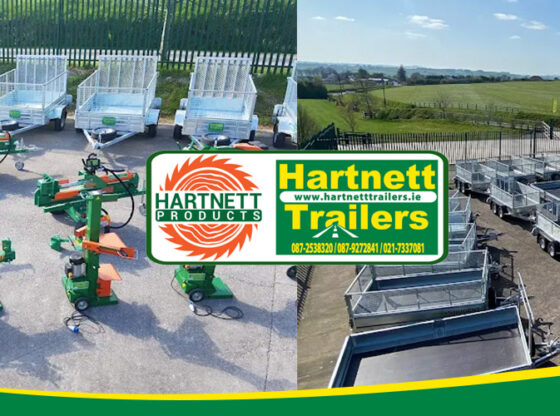
If you heat your home with a stove or open fire, you already know that splitting logs by hand is one of the most thankless jobs of the year. The axe gets blunt, the shoulders get sore, and the pile of unsplit timber in the yard never seems to shrink. There is a much better way to get the job done, and these days more and more Irish homeowners, smallholders and firewood sellers are turning to log splitters to take the pain out of the work. Whether you are processing a few cubic metres for your own stove or producing firewood for sale, the right log splitter will save you hours of labour, protect your back, and give you a steady supply of neatly split timber ready for the burner.
In this guide we will look at why a log splitter is one of the best investments you can make for your home or yard, what to consider when choosing one, and we will take a closer look at two of Ireland’s most popular models from Hartnett Products’ log splitter range: the 7 Ton Electric Log Splitter and the 8 Ton Electric Log Splitter.
Why Use a Log Splitter Instead of an Axe?
The traditional image of the woodsman swinging an axe over a chopping block is romantic, but the reality is harder on the body than most people realise. Repeated swinging puts huge strain on the lower back, shoulders and elbows, and a single bad swing on a knotty piece of ash or oak can leave you nursing an injury for weeks. Hardwoods that are common in Ireland, such as oak, beech and sycamore, can be particularly stubborn once they start to dry out, and many people simply give up on the bigger rounds and let them rot.
A log splitter changes the equation completely. Hydraulic pressure does the work that your shoulders used to do, and it does it consistently, reliably, and without ever getting tired. A round that would take ten or fifteen swings of an axe is split cleanly in a matter of seconds. The wood is split with controlled force rather than impact, which means there are no flying chips, no glancing blows, and no risk of the axe bouncing off a hidden knot. For anyone over the age of fifty, anyone with a back injury, or anyone who simply has better things to do with their weekend, a log splitter is genuinely life-changing.
There is also a quality argument. Wood that is split and stacked early dries faster, burns hotter, and produces less creosote in your chimney. If you are still chipping away at last year’s pile in November, your firewood is almost certainly burning damp. A splitter lets you process a whole load in an afternoon, get it stacked under cover, and have properly seasoned timber ready when the cold weather comes.
Electric, Petrol or PTO – Which Is Right for You?
Log splitters come in three main flavours, and choosing the right one depends on where you will use it and how much wood you need to process.
Electric splitters are the most popular choice for home use. They plug into a standard household supply, run quietly enough to use in a shed or garage, and produce no fumes. They are perfect for the average homeowner who is processing five to ten cubic metres a year, and they are by far the easiest type to live with. No fuel to mix, no engine to service, no rope to pull on a cold morning – you flick the switch and you are working.
Petrol splitters are heavier, more powerful, and designed for users who need to work away from a power supply or who are processing very large volumes. A petrol unit will happily sit in a field or a forestry block all day, and the bigger models can deliver splitting forces of 12, 25 or even 40 tonnes. The trade-off is more maintenance, more noise, and a higher purchase price.
PTO (tractor-driven) splitters sit at the top of the range and are typically used by farmers, foresters and commercial firewood producers. They use the tractor’s hydraulics to deliver enormous force and are built for heavy daily use.
For the vast majority of Irish households, an electric splitter in the 7 to 10 ton range is the sweet spot. It will handle anything you are likely to feed it, runs off a standard 230V supply, and can be wheeled in and out of the shed by one person.
What to Look for in a Quality Log Splitter
Not all log splitters are created equal, and a cheap import from a big-box retailer can be a false economy. Here are the things that really matter.
Splitting force is measured in tonnes and tells you how much pressure the ram can apply. For typical Irish hardwoods, 7 to 8 tonnes is plenty for rounds up to about 22 inches in diameter. If you are dealing with very large or very knotty rounds, stepping up to 10 or 12 tonnes is worth considering.
Motor quality is where many cheap splitters fall down. Look for a copper-wound motor rather than aluminium, as copper handles heat better and lasts much longer. A 3000W motor on a 230V single-phase supply is the standard for serious home machines.
Build quality and frame matter because a splitter takes a serious pounding every time it cycles. Heavy-gauge steel, properly welded, will last decades. Thin pressed steel will warp.
Vertical versus horizontal is a question of ergonomics. Vertical splitters let you stand up straight and tip heavy rounds onto the base plate rather than lifting them onto a bed. For anyone with a back, this is a big deal.
Safety features including two-handed operation, log guards and CE certification are non-negotiable. A log splitter is a powerful machine and the law in Ireland requires it to be properly certified.
Aftersales support is the one most people forget about until something goes wrong. Buying from an Irish supplier with a workshop, spare parts on the shelf, and someone who answers the phone is worth a great deal more than saving fifty euro on the purchase price.
The Hartnett 7 Ton Electric Log Splitter
The 7 Ton Electric Log Splitter is Hartnett Products’ best-selling machine, and for good reason. At €595 including VAT, it sits at a price point that puts it within reach of any serious homeowner, and the specification punches well above its weight.
The machine is powered by a 3000W copper-wound motor running off a standard 230V single-phase supply, which means there is no need for a special connection or a three-phase setup. It delivers 7 tonnes of splitting force, which is more than enough for the kind of seasoned hardwood and softwood rounds that most Irish households deal with. The vertical operation is the real comfort feature here – you can roll a heavy round straight onto the base plate rather than hoisting it up to waist height, and you work standing upright rather than bent over.
It will handle logs up to 23 to 30 inches in length and up to 16 inches in diameter, and the axe height is adjustable so you are not wasting time on every cycle if you happen to be splitting shorter pieces. At 85kg with built-in wheels and a handle, it can be moved around the yard by one person without too much trouble.
You also get a 12-month warranty, a 16 amp waterproof plug fitted as standard, CE certification, and full aftersales support from Hartnett’s in-house workshop in Cork. Nationwide delivery within the Republic of Ireland is a flat €39.
The Hartnett 8 Ton Electric Log Splitter
If you are processing larger volumes or routinely dealing with bigger or knottier rounds, the 8 Ton Electric Log Splitter is the natural step up. At €650 including VAT, the extra outlay over the 7 ton model gets you noticeably more capacity and a beefier frame.
The 8 ton model uses the same reliable 3000W copper-wound motor on 230V single-phase, but the hydraulic system delivers a full 8 tonnes of force – plenty to power through hardwoods, softwoods and the kind of awkward knotty pieces that always seem to end up at the bottom of the pile. The maximum log capacity is 56cm in both length and diameter, which translates to 22 inches in old money – a generous size that will swallow most of what comes out of an Irish woodland.
The machine ships with adjustable axe height, integrated safety guards, a 16 amp blue circular plug, and the same CE approval and 12-month warranty as the smaller model. At 103kg it is a little heavier than the 7 ton, but the wheels and handle make it just as easy to move around. Delivery within the Republic is €39, with Northern Ireland delivery available at €49.
For most users who burn six or more cubic metres a year, the 8 ton is probably the better long-term buy. The extra force means less time spent on stubborn pieces, and the larger capacity means you can feed it whatever you cut without having to ring rounds down to size.
A Worthwhile Investment
A good log splitter is not a luxury – it is a tool that pays for itself in saved time, saved muscle, and better-quality firewood. Whether you opt for the entry-level 7 ton or the slightly larger 8 ton, you are getting an Irish-supported machine with proper aftersales backup, real spare parts availability, and a warranty that means something. Take a look at the full range at Hartnett Products and pick the one that suits your yard, your wood, and your back.